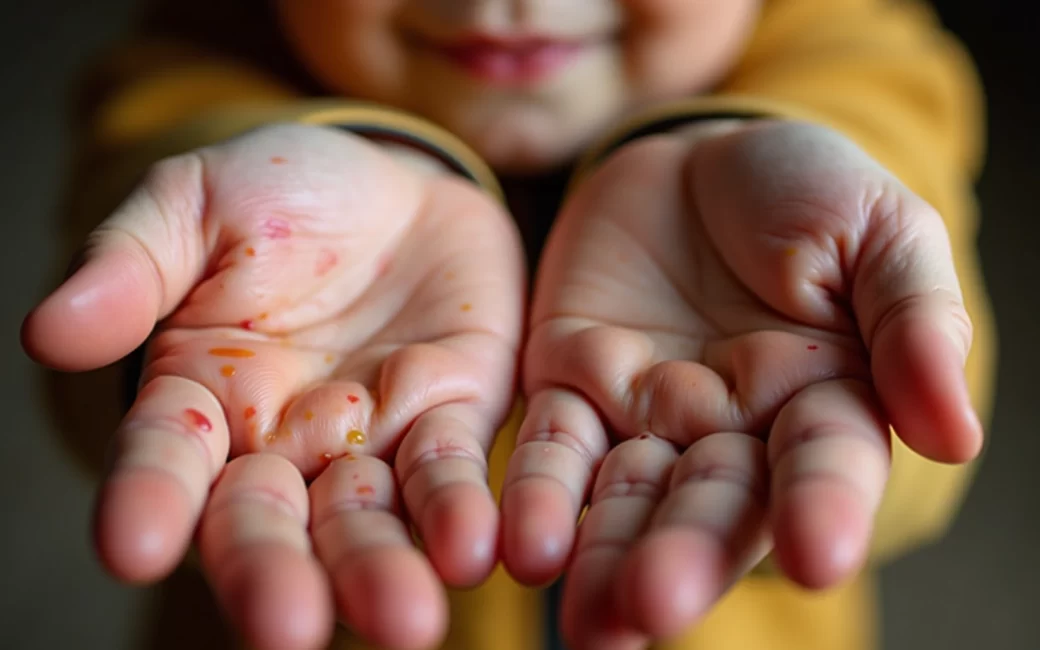
Coxsackievirus A16 is picked up through close contact or contaminated surfaces
Hand, foot, and mouth disease (HFMD) usually starts with an unremarkable fever and sore throat, days before anyone thinks to check a child's mouth or palms. The illness is most often caused by coxsackievirus A16, a member of the enterovirus group, and it spreads through saliva, mucus, blister fluid, and stool, as well as by touching toys or surfaces an infected person has contaminated, according to the CDC.
Fever and sore throat typically show up first, sometimes with reduced appetite and general malaise. One to two days later, painful sores can appear in the mouth, and a rash — flat spots or small blisters — often follows on the palms, soles, and sometimes the buttocks or knees, a pattern the Mayo Clinic describes as the classic presentation. A clinician confirms HFMD by recognizing this combination — fever, mouth ulcers, and the hand-and-foot rash — rather than through a routine lab test.
There is no antiviral medicine that shortens the course. Care is supportive: fluids, and medication for pain and fever, until the illness resolves on its own, typically within about a week to ten days, per guidance from Iowa HHS.
Painful mouth sores make swallowing hurt
The mouth ulcers, not the skin rash, are usually what makes a child miserable, because they turn ordinary swallowing into something painful enough to refuse. That refusal is the mechanism behind the illness's one common complication: dehydration.
A child who won't drink because their mouth hurts can go from mildly uncomfortable to needing IV fluids in a day or two. The fix is not to force normal meals but to manage the pain first and change what's offered:
- Give age-appropriate pain and fever medication before meals so eating hurts less, following dosing guidance from a pediatrician or pharmacist.
- Offer cool, soft, bland foods and fluids — cold milk, yogurt, smoothies, ice pops — rather than anything acidic, salty, or crunchy, which sting open sores.
- Avoid citrus juices, tomato-based foods, and chips or crackers until sores heal.
- Offer small amounts of fluid frequently rather than pushing large volumes at once.
- Watch urine output and energy level as the practical gauge of whether fluid intake is adequate.
If a child goes several hours without urinating, seems unusually drowsy, has no tears when crying, or has a fever that stays high or won't respond to medication, that warrants a same-day call to a provider rather than waiting it out, based on symptom guidance from the Texas Department of State Health Services.
An infected child sheds virus in secretions and onto toys and surfaces
A child with HFMD sheds virus in saliva, nasal secretions, blister fluid, and stool, and that shedding can continue well after the fever and rash improve — stool shedding in particular can persist for weeks, per the CDC. That long tail of contagiousness is why outbreaks move easily through child care settings, where diapering, shared toys, and close physical contact between young children create constant opportunities for transfer.
Adults in the same household or classroom, especially those doing diaper changes or wiping noses, are exposed to the same virus. Some develop the full illness, but many adults who pick up the virus have mild symptoms or none at all — infected without being visibly sick — which is part of why HFMD in a home with a symptomatic child so often quietly reaches the caregiving adult too, as described by the Lehigh Valley Health Network.
Breaking the chain relies on ordinary but consistent habits:
- Wash hands with soap and water after diaper changes, wiping a child's nose or mouth, and before preparing food.
- Disinfect shared toys, doorknobs, and other frequently touched surfaces regularly during an active case in the household.
- Avoid sharing cups, utensils, and towels with someone who is sick.
- Keep a child with fever or open mouth sores home from child care or school until a provider or facility guidance says it's safe to return.
Can adults get hand, foot, and mouth disease from a child?
Yes. Adults can catch the same coxsackievirus that causes HFMD in children, usually through the same routes — contact with saliva, blister fluid, stool, or contaminated surfaces — and it happens most often to parents and caregivers of an infected child, according to the Lehigh Valley Health Network. What differs is how it shows up: many infected adults have no symptoms or only a mild sore throat and skin irritation, so an adult can be contagious without looking sick, which is why handwashing and surface cleaning matter even when the adult in the house feels fine.
How long is hand, foot, and mouth disease contagious?
There isn't a single clean number, because different body fluids carry the virus for different lengths of time. A person is generally most contagious during the first week of illness, while fever and mouth sores are present, but virus can still be detected in respiratory secretions for one to three weeks and in stool for several weeks after symptoms resolve, per CDC guidance. Many child care programs use resolution of fever and mouth sores, rather than a fixed calendar date, as the practical marker for allowing a child back into group settings, echoing the return-to-care approach in Iowa HHS guidance.
How is HFMD different from chickenpox or herpangina?
The rash location and the mouth-sore pattern are the fastest way to tell these apart. Chickenpox produces itchy blisters scattered over the whole body and face, not concentrated on palms and soles, and herpangina causes sores at the back of the mouth and throat without the hand-and-foot rash that defines HFMD, a distinction outlined by the Mayo Clinic. Human HFMD is also an entirely different disease from foot-and-mouth disease in livestock — they share a name but not a virus, a species, or a mode of transmission.
What happens after the rash and sores clear up
Recovery from HFMD isn't always the end of visible signs. Some children lose one or more fingernails or toenails, or notice skin peeling on the hands and feet, in the weeks following infection — a delayed effect that resolves without treatment as new nail growth resumes, as described in illness-sheet guidance from UCSF. Because more than one enterovirus strain can cause HFMD, having it once does not guarantee lasting immunity, and a child or adult can be infected again by a different strain later.
What to do next
If a child has fever, sore throat, and mouth ulcers together with a rash on the palms and soles, that combination is enough to call a pediatrician for confirmation rather than guessing between HFMD and something else. Keep pain medication on a schedule, offer cold soft foods instead of forcing normal meals, and track wet diapers or bathroom trips as the simplest sign that fluids are going in well enough. Anyone caring for the child should wash hands often and clean shared surfaces daily until the fever and sores are gone, since that's the window when spread is most likely.